


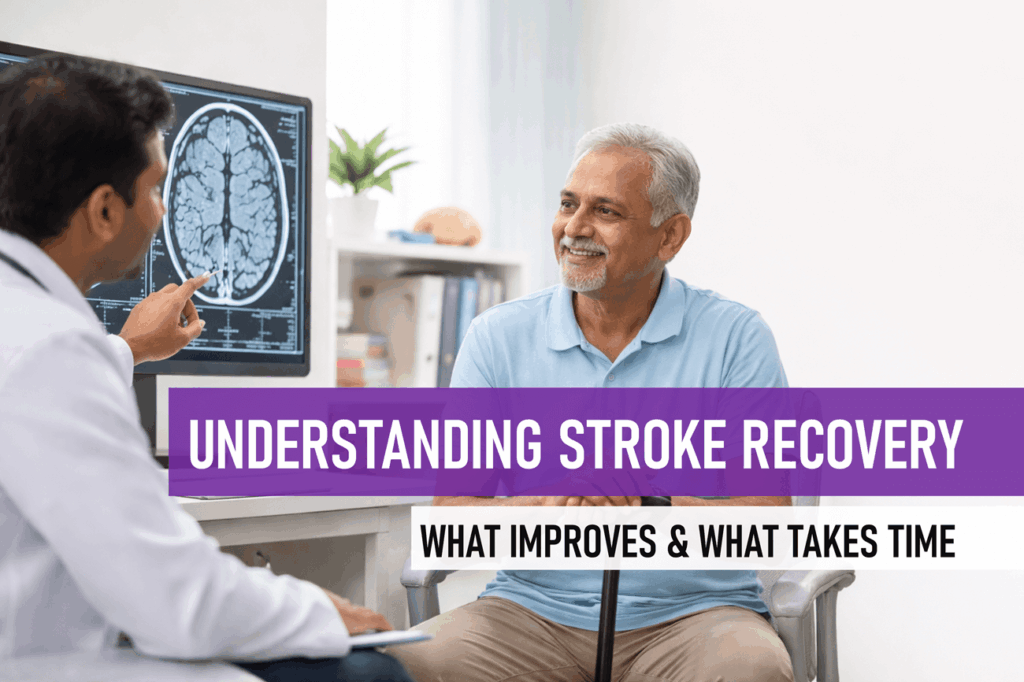
A stroke can change life suddenly — not just physically, but emotionally for patients and families. After the emergency phase, one of the most common questions is:
“Will this improve?”
The answer is yes — but recovery happens step by step, and not all symptoms recover at the same pace. Understanding what improves early and what takes time helps set realistic expectations and reduces anxiety during brain stroke recovery.
Why stroke recovery is different for every patient
Stroke recovery depends on:
- Which part of the brain is affected
- Severity of damage
- Speed of treatment
- Age and overall health
- Consistency of rehabilitation
A stroke treatment doctor or stroke recovery specialist evaluates these factors to guide recovery planning and long-term care.
Speech problems after stroke: what to expect
Many patients experience speech problems after stroke, especially when the left side of the brain is involved. This may include:
- Difficulty finding words
- Trouble understanding speech
- Slurred or unclear speech
What often improves sooner
- Basic communication
- Naming common objects
- Understanding simple instructions
What takes longer
- Fluent conversation
- Reading and writing
- Word recall under stress
Early and regular speech therapy plays a major role in improvement.


Memory & thinking difficulties after stroke
Memory loss after stroke is common and often misunderstood. It may involve:
- Forgetting recent events
- Reduced attention span
- Slower thinking
- Difficulty planning tasks
In many cases, this is related to attention and processing speed rather than permanent memory loss.
What improves earlier
- Orientation (knowing date/place)
- Attention
- Simple recall
What takes time
- Multitasking
- Complex decision-making
- Short-term memory under pressure
Mental exercises, routine and neurological follow-up are key parts of post stroke rehabilitation.


Weakness, balance & movement problems
Weakness after stroke usually affects one side of the body and may involve:
- Arm or leg weakness
- Poor coordination
- Balance issues
- Stiffness or spasticity
Improvement happens due to neuroplasticity — the brain’s ability to rewire itself.
Early gains
- Muscle activation
- Sitting balance
- Basic standing
Gradual recovery
- Walking confidently
- Hand coordination
- Fine motor control
Physiotherapy started early gives the best results.
Read More on Understanding Movement Disorders
Stroke recovery timeline: what is normal?
| Time Period | What Happens |
|---|---|
| First few weeks | Rapid improvement as brain swelling reduces |
| 1–3 months | Best window for rehabilitation |
| 3–6 months | Slower but steady recovery |
| Beyond 6 months | Functional gains still possible |
Recovery continues with therapy and motivation, even months later.
When should you revisit a neurologist?
Follow-up with a neurologist in Ahmedabad is important if:
- Recovery plateaus
- New symptoms appear
- Seizures or stiffness develop
- Memory or behavior worsens
Patients often search online for a stroke doctor near me or the best neurologist for stroke care when they need guidance beyond routine therapy.
Final Takeaway
Stroke recovery is a journey – not a race.
Speech, memory, and movement often do improve, but each at its own pace. With timely therapy, regular follow-up, and proper guidance from a specialist, meaningful recovery is achievable for most patients.
Timely neurological guidance supports better stroke recovery.
Need an appointment? Contact us or drop us a message. or visit Setu Neurology Clinic in Ahmedabad.
Banner Image Credit: ChatGPT AI